EPC Dialogues - Dubai: A designer's invisible edge.
EPC Dialogues, held in Dubai, brought global designers together to explore The Invisible Edge. These subtle human abilities help designers notice, interpret, and shape meaningful work. This recap distils the talks, panels, and reflections that unfolded through the day.

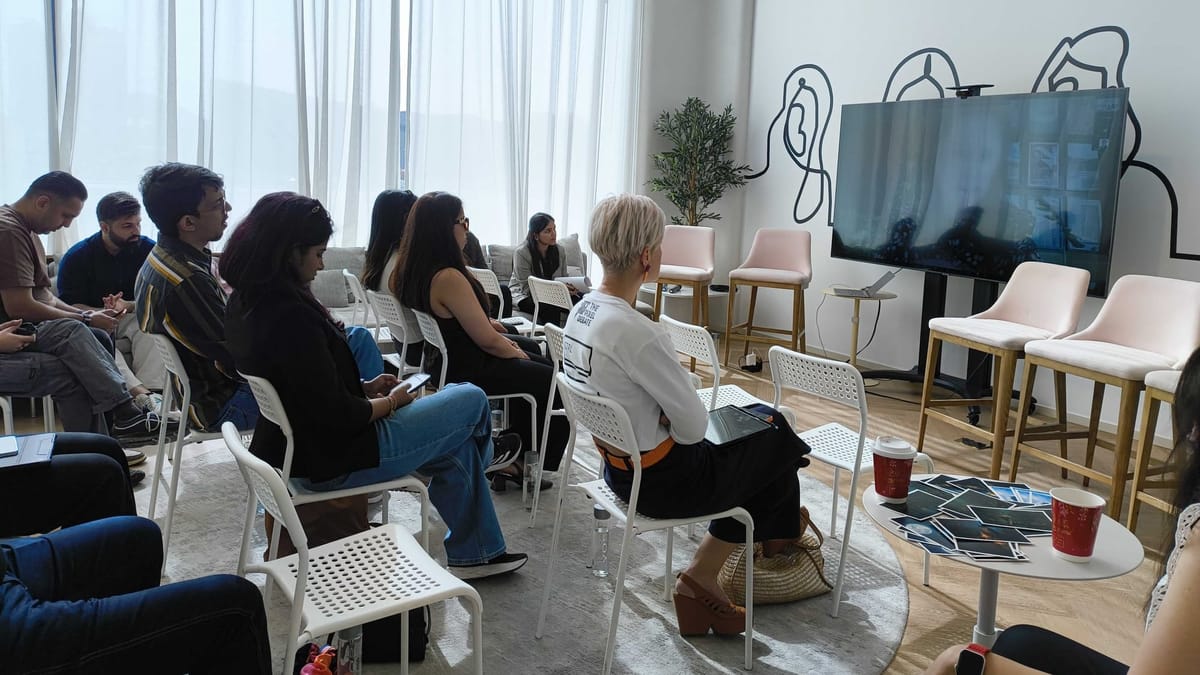
EPC Dialogues brought together designers and leaders from around the world for a full day of talks, panels, and collaborative conversations. The theme running through the day was the designer’s invisible edge—the subtle, often overlooked human abilities that enable designers to notice, interpret, influence, and create the conditions for meaningful work.
This blog brings together everything that unfolded in the dialogues.
Seeing the World with Depth
The day began with talks focused on how designers notice, interpret, and make sense of the world.
Louise Halliwell, Experience Design Director at Folk, opened with “Design as the Art of Noticing”. She spoke about how designers tune noise into meaning, read subtle signals, rely on human intuition, and use disciplined empathy.
Designers work inside “living systems” such as healthcare, education, and public services, where signals are often noisy, subtle, and layered. According to Louise, the act of noticing begins long before a brief is created. Designers must read tone, hesitation, emotional cues, and what remains unsaid. This is where human intuition becomes essential, because it allows designers to detect emotional self-protection that AI cannot interpret.
One example came from her scam-reporting project with a government agency. Although low reporting rates were initially attributed to usability problems, the team discovered that the real barrier was a finding that surfaced only through careful observation of micro-signals during interviews. A second case from Australia’s first digital mental health service showed a similar pattern. Here, users carried a baseline distrust due to past stigma and social exclusion, which meant the product needed to be framed in terms of respect and safety from the very beginning.
Louise emphasised that discernment, rather than speed, is design’s actual value in the age of automation. Designers, she said, must learn to notice what matters, name it clearly by involving the people affected, and nurture the conditions in which trust, meaning, and clarity can grow.