Sound is a Design material
Design goes beyond what we see. Drawing from The Power of Sound at London Design Festival 2026, this article explores how sound shapes emotion, attention, movement and memory, and why designers must consider it an essential part of creating meaningful experiences.
Design has always had a strong visual bias. We spend a great deal of time thinking about what people see: colour, typography, interfaces, materials, lighting, imagery, layouts and physical form. We review products through screens, present architecture through drawings and renders, and recognise brands through visual systems. Yet people do not experience the world only through their eyes. Sound plays an equally important role in shaping how a place feels, how we behave within it, what we pay attention to and how we remember it.
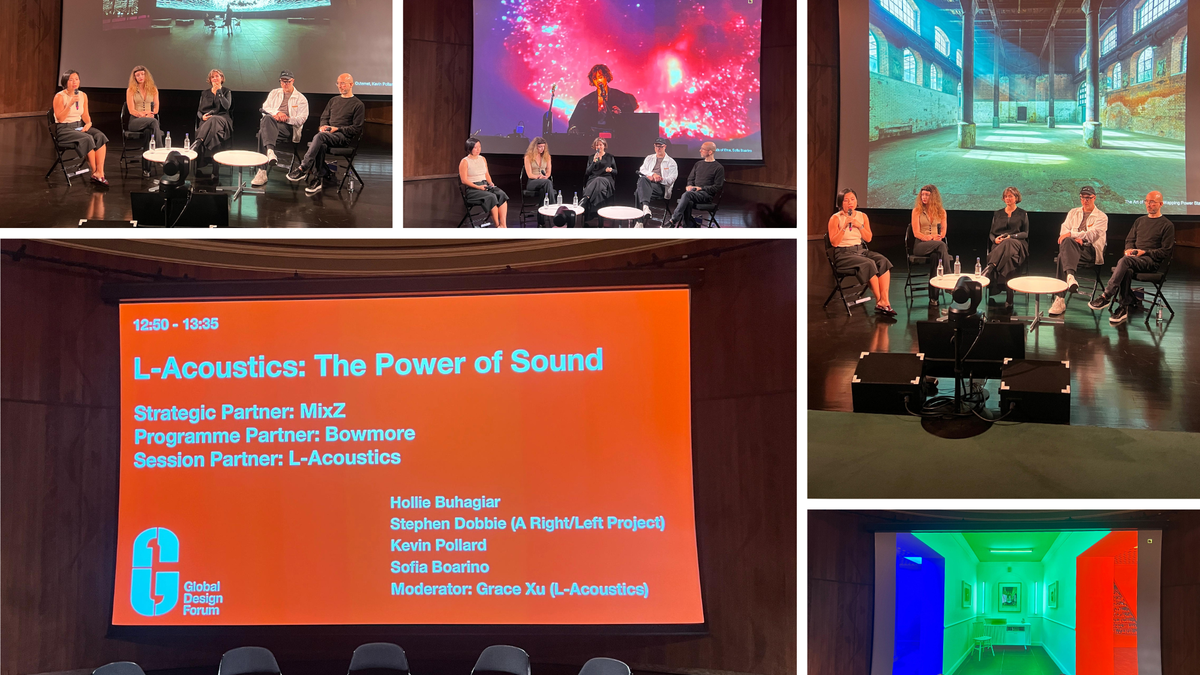
During London Design Festival 2026, members of the Extended Pack Collective attended L-Acoustics: The Power of Sound, a Global Design Forum session exploring sound across architecture, composition, sound art and immersive experience.
Led by Grace Xu, Architecture Engagement Global Lead at L-Acoustics, the panel brought together Hollie Buhagiar, a film and television composer; Sofia Boarino, an architect, researcher and sound artist; Stephen Dobbie, a sound designer and creative director working across immersive storytelling; and Kevin Pollard, a sound artist, music producer and composer whose practice also draws on a background in architecture.
This range of practice gave the conversation its breadth. Sound was considered as vibration, atmosphere, narrative, technology and part of the built environment. For designers, product managers, entrepreneurs and business owners, the discussion raised a broader question: what changes when visual design, space, technology and sound are considered together rather than in sequence?
Sound as a material
Every sound can be treated as a material. This is easy to understand when compared with architecture or industrial design. Fabric produces a different response from polished metal. The choice of material affects weight, texture, temperature, movement and perception. Sound can do something similar without changing what we see.
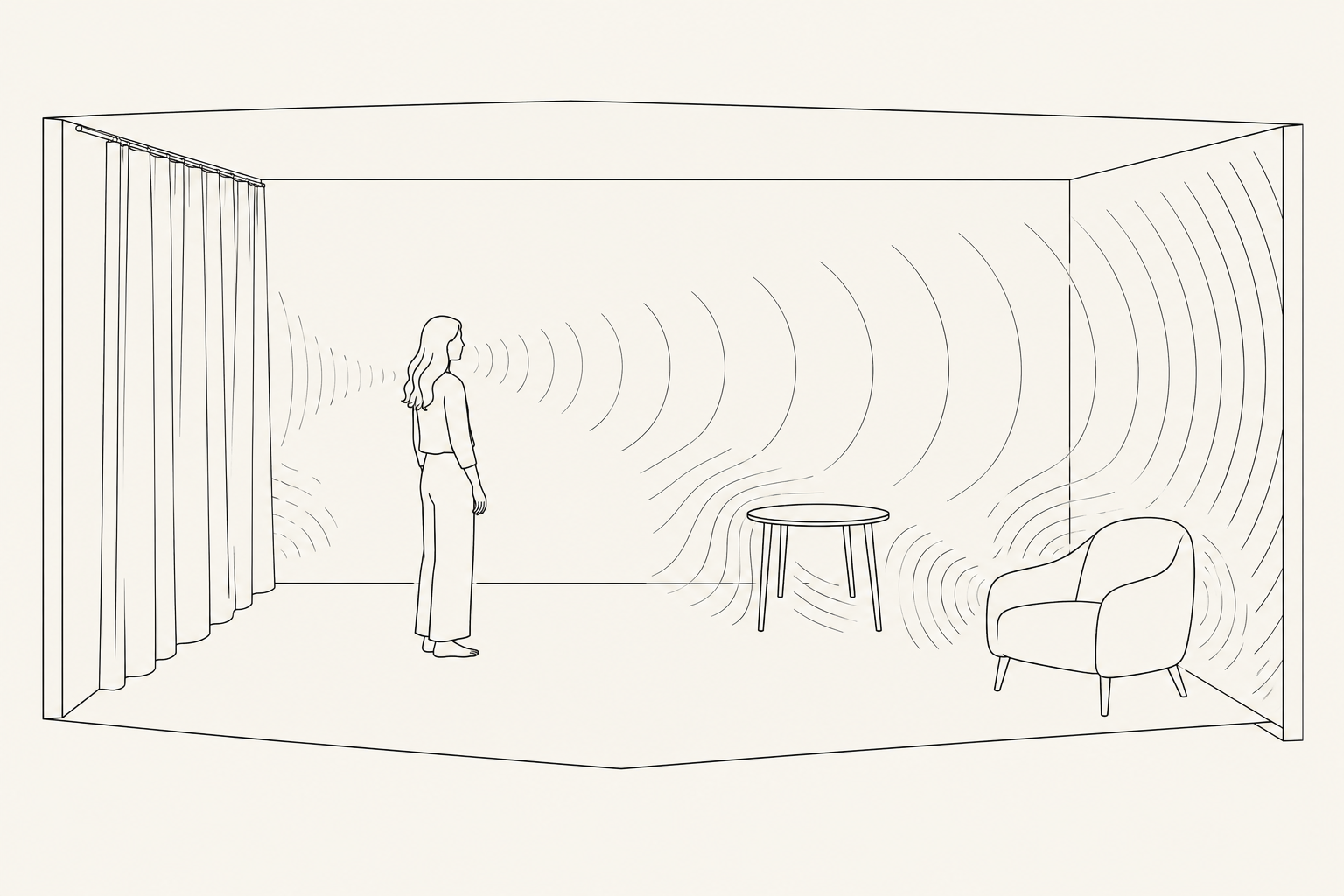
Sound is also physical. It travels as vibration through space, interacts with matter and affects the body. Rooms, objects and surfaces all shape how it behaves. A space therefore has an acoustic character whether a designer consciously creates it or not. In that sense, sound is never completely absent from an environment. It is always present in some form, whether through conversation, machinery, traffic, wind, movement, ventilation or silence.
This gives sound a different relationship with people compared with many visual elements. We can choose to look away from an object, but sound continues to occupy the space around us. Hearing is immersive by nature. Even without seeing something, we can often understand the size of a room, the distance of an object or the direction of movement through sound alone. This ability to surround and orient people makes sound a powerful part of experience design.
Designing around feeling rather than appearance
A recurring idea in the discussion was that the starting point should not always be what people are supposed to see. Instead, it can be how they are meant to feel.
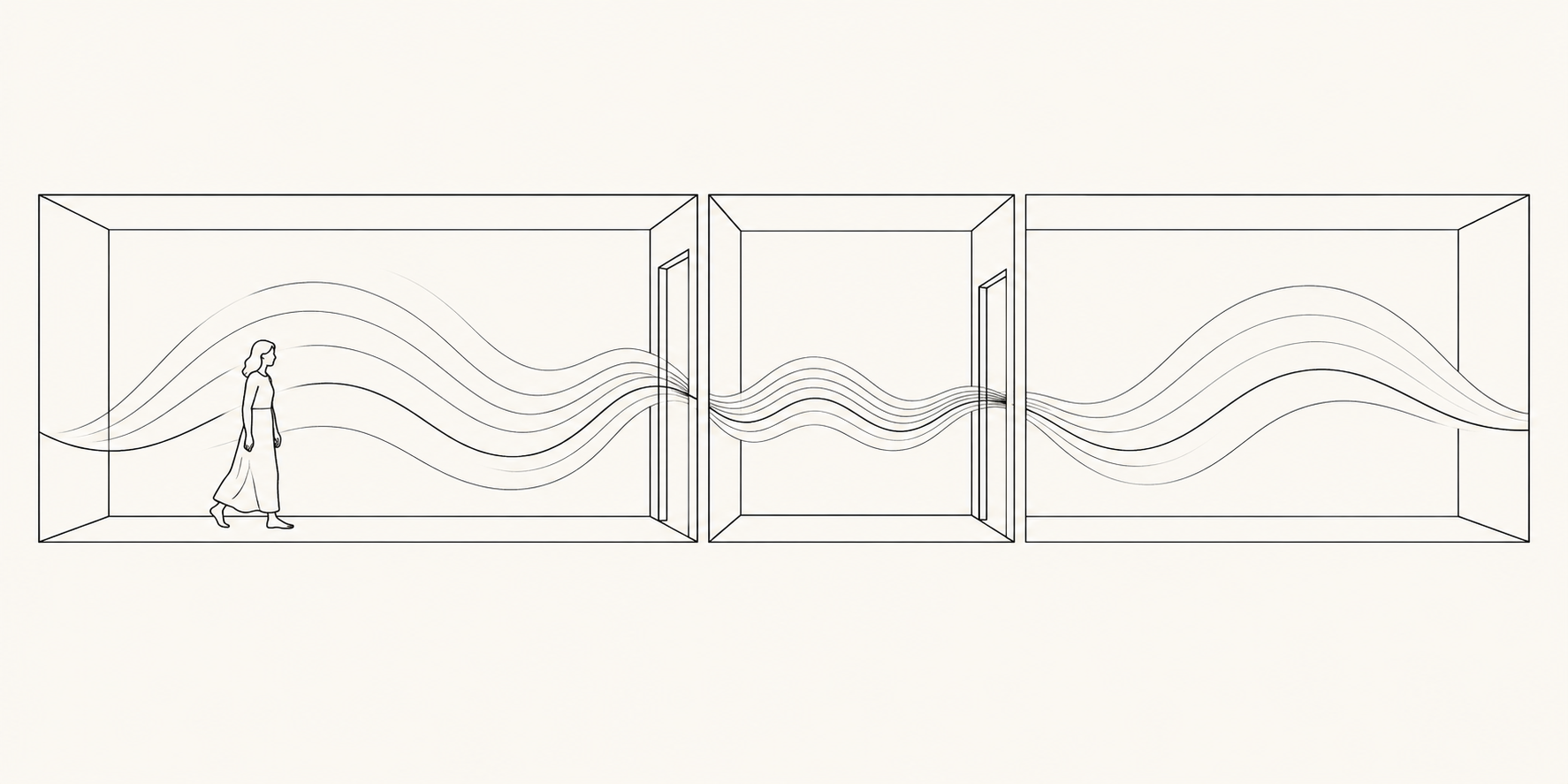
A building can be designed as a plan, but it can also be understood as a sequence of experiences that happen over time. Someone approaches the building, enters it, moves through a narrow passage, discovers a larger space, pauses and eventually leaves. Each moment can carry a different emotional quality.
This way of thinking overlaps with composition and storytelling. Music unfolds through time, as do film, theatre and any well-designed journey. The experience is not contained in one static moment, but in the relationship between many moments. Sound becomes particularly useful here because it can help create atmosphere, build anticipation, introduce contrast or signal a transition without needing to explain itself.
Seen this way, design is not only an arrangement of objects but a composition of moments. Arrival, movement, pause and departure become part of the same experience, with sound helping establish continuity and change across them.
The same principle applies to retail environments, hospitality, exhibitions, workplaces, and digital products. A customer journey is also a sequence of moments. It includes arrival, orientation, interaction, decision, and exit. Thinking about these moments as an unfolding experience changes the role of design. The focus shifts from simply arranging information or objects towards shaping how someone moves through a situation and what they feel while doing so.
Helping people understand where to focus
Sound becomes even more important in immersive environments where there may not be a single obvious point of attention. A cinema is relatively simple. The seats face one direction, the screen establishes the focus, and the environment makes it clear what the audience is expected to do. Immersive installations, exhibitions, and interactive spaces differ because several things may be happening at the same time.
When people enter these environments, they need to understand where their attention can go and what kind of participation is expected. Should they remain still, walk around, interact with something or simply observe? When an environment contains multiple screens, sound sources, lights and interactive elements, the absence of guidance can quickly create confusion.
Sound can play an important role in addressing this problem. It can draw attention to a particular part of a room, make activity outside the field of view perceptible or signal a transition from one area to another. This does not require explicit instructions. The environment itself can gradually help a visitor understand how to move through it.
Directing attention did not mean controlling every movement. It meant giving people enough orientation to understand the environment while preserving room for exploration and discovery.
This idea is useful far beyond physical installations. Good digital products do something similar. They manage attention through hierarchy, timing, feedback and interaction. The broader principle is that designers need to think carefully about where they direct attention. More information, more movement or more technology does not automatically create a better experience. An environment becomes useful when people can understand what matters at a particular moment.
Moving the audience from observer to participant
Traditional media usually establishes a clear relationship between the work and its audience. In film, people watch a screen. In theatre, they watch performers. The content is presented in front of them. In most digital interfaces, the content appears in front of the user.
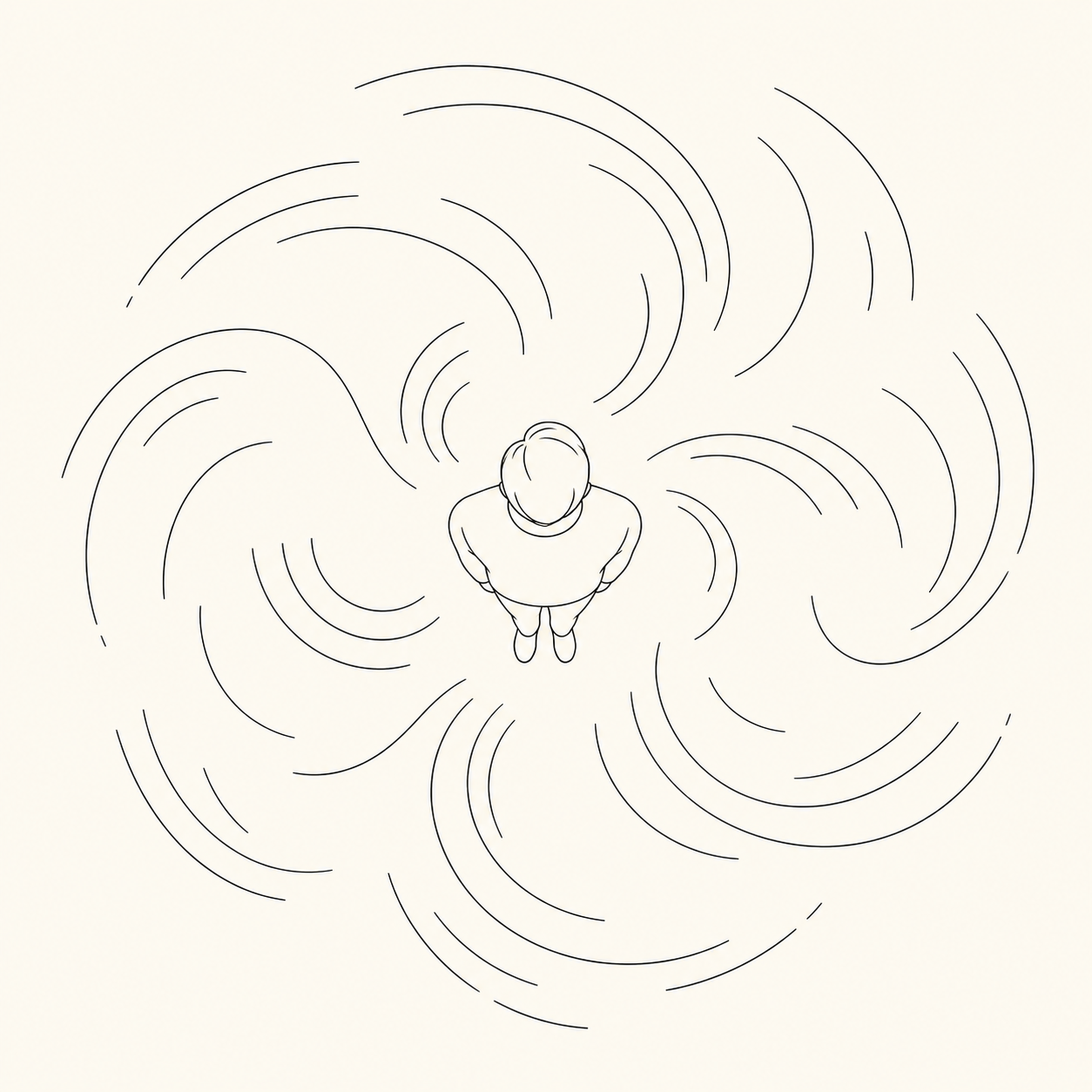
Spatial sound changes this relationship because the audience can become part of the environment rather than simply observing it from outside. One example discussed during the session involved a spatial audio composition in which the listener could experience being surrounded by a choir rather than hearing it from a conventional front-facing position.
The difference may appear technical, but it changes the experience substantially. The audience member is no longer positioned outside the composition. They occupy its centre. The work becomes something they are inside rather than something they are looking at.
Once the audience can move, turn and choose where to focus, the work is no longer presented from a single viewpoint. It becomes an environment that has to be encountered from within.
This is increasingly relevant as more experiences move away from fixed frames. Spatial computing, interactive installations and mixed-reality environments all challenge the assumption that people will experience content from one predetermined viewpoint. Designers are therefore beginning to think less about presenting something to an audience and more about constructing an environment that an audience can inhabit.
Technology should serve the experience
Technology was naturally a significant part of the discussion. Spatial audio, motion capture, sensors, coding and AI are creating new possibilities for artists and designers. Some experiences discussed during the session brought together live performance, environmental data, sound and digital systems in ways that would have been difficult to achieve even a few years ago.
Across these examples, technology supported the creative intention rather than becoming the experience's subject.
It is easy to become fascinated by what a new tool can do. This happens whenever new technology enters a creative discipline. The capability itself can become the focus, with experiences designed around demonstrating it. That may produce interesting experiments, but novelty alone rarely creates lasting value.
The stronger examples were those in which technology enabled relationships that had previously been difficult to create. Movement could influence sound. Environmental activity could become part of a live performance. Architecture could respond to a composition. Data could become part of a physical experience. What made these situations compelling was not simply that technology was present, but that previously separate elements could interact.
This is particularly relevant to the current discussion around AI in design. The most productive use of AI may not come from asking what it can replace. It may come from understanding what kinds of relationships, behaviours or experiences it allows designers to create that were previously difficult or impossible.
The opportunity between disciplines
Many of the projects discussed during the session existed between traditional disciplines. Architecture met composition. Sound met neuroscience. Performance met technology. Nature met data. Physical environments interacted with digital systems.
This offers an important lesson for designers. Some of the most interesting opportunities may not exist within established disciplines but between them.
A product designer who understands behavioural science sees interfaces differently. An architect who understands acoustics begins to think differently about materials and proportions. A composer who understands technology can work beyond traditional formats. A technologist who understands storytelling can create interactions that feel more coherent and purposeful.
This does not mean every designer needs to become a specialist in several fields. It does mean that the ability to collaborate across disciplines is becoming increasingly valuable. Understanding the language, possibilities and constraints of adjacent practices allows people to work on problems that would otherwise remain disconnected.
Sound is a good example because it naturally moves between fields. It is artistic, technical, architectural and physiological at the same time. Thinking about it seriously encourages designers to move beyond the boundaries of their own discipline.
Sound needs to enter the process earlier
Perhaps the most practical takeaway from the session was the need to bring sound into the design process earlier.
In many projects, sound is considered only after important decisions have already been made. A building has been designed, an exhibition space has been selected, a film has been edited, or an experience has already been structured. At that point, a composer or sound designer is invited to add another layer. This approach limits what sound can contribute.
If sound is considered early, it can influence the shape of a room, the choice of materials, the scale of an installation, the placement of people and even the selection of the venue itself. It becomes part of the experience's architecture rather than a finishing layer.
This reflects a broader design principle. Any discipline that can fundamentally shape an experience needs to be involved while important decisions are still open. Accessibility should not be introduced after an interface is complete. Research should not be used simply to validate decisions already made. Technology should not arrive only after an experience has been defined. When these disciplines enter earlier, they can influence the direction of the work rather than simply modify the result.
Designing sound does not always mean adding more sound
Towards the end, the conversation turned to the idea that sound design does not necessarily mean adding music or increasing the amount of audio in an environment. Sometimes the right decision is to remove something.
Silence can create contrast. The absence of music can let a particular moment carry more weight. Reducing sound can make another sound stand out more. These are design decisions in the same way that whitespace, reduction and restraint are design decisions in visual communication.
This principle is worth remembering because creative work often becomes associated with addition. Teams add features, screens, information, interactions and effects because addition is visible and easy to demonstrate. Removal requires confidence. It depends on understanding which elements are essential to the experience and which simply occupy space.
Sound therefore reminds us that good design is not measured by how much has been added. It is often defined by how clearly the necessary elements have been chosen.
The importance of entering and leaving an experience
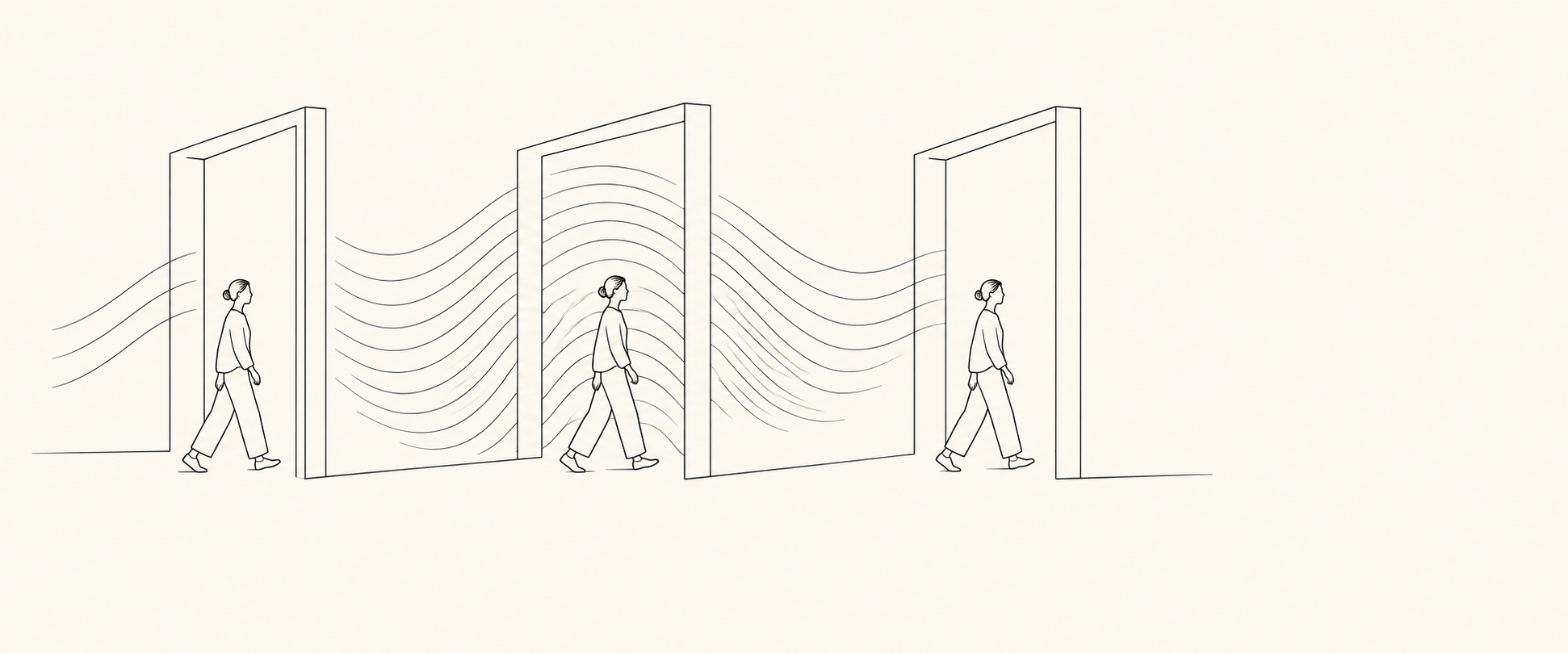
Another useful idea from the session concerned how people enter and leave an experience. In product design, considerable attention is given to onboarding. People need to understand how a system works before they can use it comfortably. Immersive environments need something similar, but they also benefit from careful offboarding.
Sound can create strong emotional and physiological responses. If an experience creates a contemplative, intense or unusual atmosphere, immediately returning a visitor to a bright corridor, crowded street or another piece of content can interrupt the effect of the experience.
Some of the practitioners in the session spoke about deliberately creating space for people to process what they had just experienced. This might involve a quieter environment, a slower transition or simply enough time for the experience to settle before the visitor moves on.
This idea applies to many other forms of design. The final moments of an experience often influence how the entire experience is remembered. Retail, hospitality, digital products, and events all have opportunities to think more carefully about what happens after the primary interaction ends.
From noise reduction to soundscape design
Design and architecture have traditionally spoken about sound largely through the language of noise. We try to remove unwanted sounds, reduce echoes, block traffic or create quieter environments. These concerns matter, but they represent only one side of our relationship with sound.
The discussion suggested a broader approach. Instead of thinking only about which sounds to remove, designers can also consider which sounds deserve to remain. The voices of people in a home, birds outside a window, movement within a neighbourhood or sounds produced by particular materials can all contribute to a sense of place.
This changes the conversation from simple noise reduction towards soundscape design. The goal is not necessarily to make everything quieter. It is to shape the acoustic environment in a way that helps people remain connected with where they are.
That connection becomes particularly important as cities, buildings and digital systems become increasingly controlled and mediated. Removing every irregularity from an environment may also remove some of its character. Sound can help maintain a relationship between people and the places they occupy.
Designing beyond what we can see
The Power of Sound was ultimately about more than audio. It raised a broader point about the materials designers choose to pay attention to.
People experience products, spaces and services through a combination of sight, sound, movement, behaviour, memory, atmosphere and time. Yet our design processes often separate these elements because professional disciplines have developed around them independently.
The opportunity is to think about them as parts of the same experience.
Sometimes architecture leads. At other times, lighting, interaction, sound, performance or technology may become more important. Design's role is not to make every element equally prominent. It is to understand how they can work together and which one needs to lead at a particular moment.
Sound is particularly useful because it exposes how visually dependent much of design has become. Once designers begin listening to an environment as carefully as they look at it, different questions emerge about attention, atmosphere, emotion, movement, and connection.
To discover more of EPC events and documentation on this journal, follow our Luma calendar page. EPC is an invite-only global community of designers and leaders.

Comments ()