The future of mobility: why better technology still needs better Design
As AI, electric vehicles and advanced manufacturing transform mobility, designers face a larger challenge: making technology simpler, more human and genuinely useful. Insights from a London Design Festival 2026 discussion on the future of transportation design.
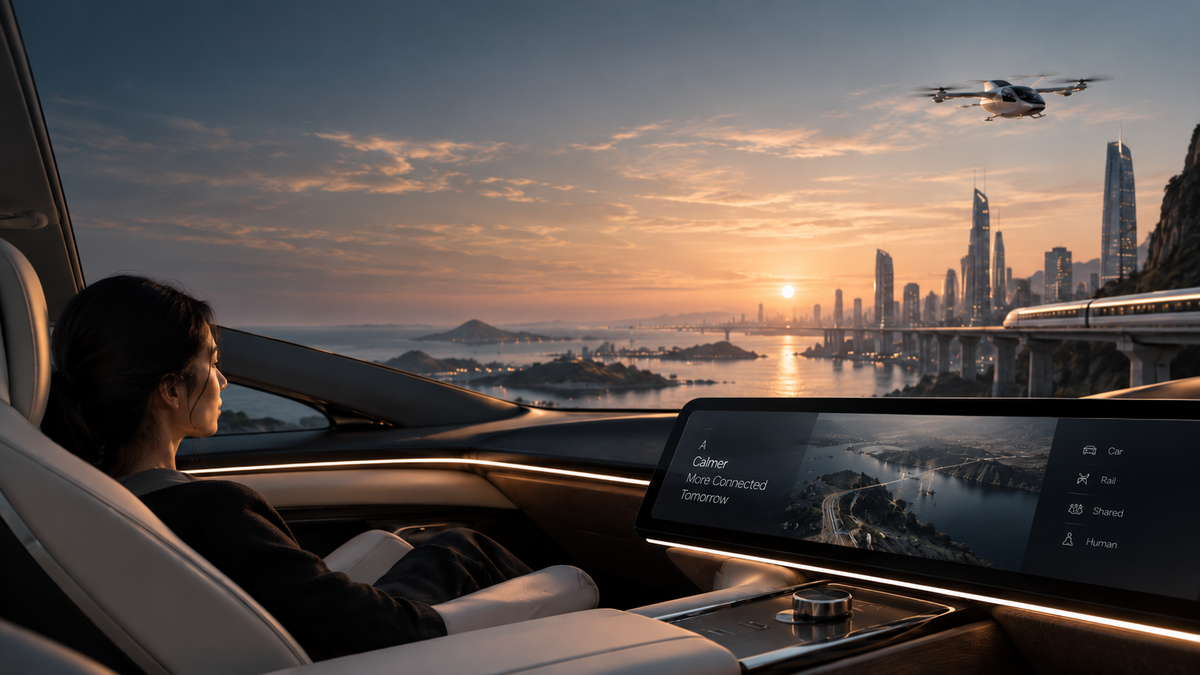
Mobility is becoming an experience, not just a means of transportation
The transportation industry is going through one of its most significant periods of transformation. Electric vehicles, autonomous driving systems, connected technologies and new manufacturing processes are changing how vehicles are designed, produced and experienced. However, alongside these technological developments, something equally important is changing: what people expect from the vehicles and transportation services they use.
During the London Design Festival 2026, members of the Extended Pack Collective (EPC) attended a discussion that brought together perspectives from automotive design, aviation design and design journalism. The conversation featured Steve Eum, Vice President and General Manager of Design at Chery Automobile; Daniel Maclnnes, Director at Priestman Goody; and Jonathan Bell, a transport and technology editor at Wallpaper. Moderated by Dr. Jiayu Wu, Reader in Intelligent Mobility Design at Royal College of Art.
The discussion explored the relationship between technology, craftsmanship, manufacturing and human experience. While much of the conversation centred on automotive and aviation design, the underlying ideas are relevant to anyone creating products, services, or experiences.
One of the most important themes was that technological advancement does not automatically translate into a better experience. As products become more capable, designers have an increasing responsibility to make those capabilities understandable, accessible and genuinely useful.
Manufacturing is no longer simply a constraint on design
For much of industrial design's history, the relationship between design and manufacturing has involved negotiation. Designers imagine possibilities, while engineers and manufacturers determine how to produce them within technical and commercial limitations.
Advancements in precision engineering, materials and manufacturing technologies are changing this relationship. Complex forms, sophisticated finishes and detailed components can now be manufactured at scale and levels of consistency that were previously difficult to achieve.
Steve explained that automotive design requires constant coordination between artistic expression, engineering and manufacturing. A vehicle contains thousands of interconnected decisions, from its overall proportions to the smallest interior details. The final product must maintain a consistent design language while satisfying engineering, safety and production requirements.
This makes manufacturing an active participant in the design process, not simply the final stage of production.
For designers, the opportunity lies in understanding manufacturing possibilities early enough to influence the product itself. Knowledge of materials, fabrication techniques, and production methods can expand the range of ideas designers can develop.
The same principle applies beyond physical products. In digital product development, a designer who understands the capabilities and limitations of software engineering can make more informed decisions. In service design, an understanding of operational systems can lead to solutions that are both useful and practical to deliver.
Design quality depends not only on what can be imagined, but also on how intelligently it can be realised.
Technology should make experiences simpler, not more complicated
Modern vehicles are becoming increasingly sophisticated. Cameras, sensors, radar systems, connected services and intelligent assistance technologies are now part of the driving experience. While these technologies offer meaningful benefits, they also introduce new challenges for designers.
Steve highlighted the importance of integrating technology without letting it dominate a vehicle's visual or functional experience. Additional technology should not automatically add complexity for the person using it. This distinction is particularly relevant as automotive manufacturers introduce larger displays, additional controls and increasingly complex digital systems.
A vehicle may contain advanced technology, but the person driving it still needs to perform relatively straightforward activities: adjust the temperature, navigate, communicate, understand the surroundings and reach a destination safely. When basic actions become more difficult because of the technology introduced to support them, the experience has arguably moved in the wrong direction.
One example discussed was using a smartphone instead of a physical car key. The underlying system may be technically complex, but the experience becomes simpler because it removes an object and an action from everyday life.
This is an important principle for product teams working with emerging technologies. The value of innovation should not be measured only by the number of capabilities introduced. It should also be measured by how much unnecessary effort those capabilities remove.
A well-designed technological experience allows people to benefit from sophisticated systems without having to understand their complexity.
Digital interfaces have limits, and physical interaction still matters
One of the most practical discussions concerned the growing dependence on touchscreens in vehicles. Over the past decade, automotive manufacturers have increasingly moved physical controls into digital interfaces. Functions that previously had dedicated buttons or switches are now frequently accessed through menus and touchscreens.
This transition has obvious advantages. Digital interfaces are flexible, support software updates, and let manufacturers add new capabilities without redesigning physical hardware. However, removing physical controls can also make common tasks harder.
The discussion highlighted a familiar example: adjusting air conditioning through a touchscreen menu rather than using a physical control. What was once a simple action can become a sequence of interactions that requires visual attention.
Steve described how customer feedback has encouraged the reintroduction of tactile elements, including physical buttons and controls that provide clearer feedback.
This is particularly important in transportation because use conditions differ from those of a smartphone or desktop application. Drivers often need to operate controls while maintaining attention on the road. Physical controls can support interaction through touch and familiarity, reducing the need to look away.
Daniel also reflected on large digital interfaces in aviation, where passengers may have access to many functions but use only a small proportion of them.
Digital interaction is not inherently better than physical interaction. The appropriate interface depends on the task, the environment and the person using it.
For product managers and designers, this means avoiding the assumption that every function needs to be digitised. A useful design exercise is to identify which interactions benefit from flexibility and which require speed, reliability and immediate feedback.
The future may not belong entirely to digital or analogue interfaces. It may belong to products that combine both intelligently.
Customer expectations are changing faster than product categories
Another important observation was the rising expectation of quality across different price categories and transportation experiences.
Daniel noted that people have become more demanding about the environments, materials and interactions they encounter. Features and finishes once associated with premium products are increasingly expected in more accessible offerings.
This change is not limited to automobiles. People experience products across multiple industries, and those experiences influence what they expect elsewhere. Someone accustomed to the quality of a well-designed vehicle may carry similar expectations into an aircraft cabin. Likewise, someone familiar with intuitive digital services may expect transportation interfaces to behave with comparable simplicity.
The discussion highlighted how aviation designers are exploring materials, finishes and interaction details traditionally associated with automotive design. The intention is to improve the quality of the passenger environment rather than treat an aircraft interior as an isolated category. This creates an important opportunity for designers to look beyond their immediate industry.
A financial application can learn from the clarity of consumer electronics. A healthcare service can learn from hospitality. Enterprise software can learn from the simplicity of everyday consumer products. Product categories may be different, but the people experiencing them are often the same.
Customer expectations are shaped by the best experiences people encounter, not merely by competing products in the same industry.
For business owners, this has commercial implications. Benchmarking exclusively against direct competitors may overlook changes in what customers consider normal, convenient or valuable.
The vehicle interior is becoming an environment in its own right
The conversation also explored how the role of vehicle interiors is changing. Traditionally, automotive interiors have been designed primarily around driving. Controls, seating, visibility and instrumentation are organised to support the driver and passengers during a journey.
However, growing traffic congestion, longer periods spent inside vehicles and the gradual development of autonomous technologies are expanding the brief. A vehicle interior increasingly needs to function as a comfortable environment rather than simply a space that accommodates transportation.
This changes the importance of materials, seating, lighting, interfaces and the overall atmosphere. A passenger may want to work, rest, communicate or enjoy entertainment during a journey. A driver may want an environment that reduces fatigue and makes time spent in traffic more comfortable.
The design challenge is therefore becoming broader than vehicle operation. It involves understanding how people experience time, comfort and personal space.
Autonomous technology could eventually accelerate this transition by reducing the attention required for driving in situations where automation is available and safe. For designers, this suggests a shift from organising individual functions to designing complete environments around human activities.
The same thinking can apply to workplaces, retail spaces, hospitality services, and digital ecosystems. Instead of considering individual features in isolation, teams can examine the conditions required for a more comfortable, productive and meaningful experience.
AI can accelerate design, but it cannot replace design judgement
Artificial intelligence was another significant topic, particularly in relation to the future of creative work. The panel discussed how AI, virtual reality and other emerging tools are changing design workflows. These technologies can help teams explore possibilities, visualise concepts and shorten parts of the development process.
In automotive design, AI also has potential applications beyond the creative process, particularly in supporting safer and more comfortable transportation. However, the discussion drew an important distinction between generating possibilities and making design decisions.
Daniel described AI as a tool that can help make ideas possible rather than something that should take creativity away from designers. Even as these tools become more capable, experienced designers remain necessary to evaluate outcomes, refine details and maintain quality. This distinction matters because design involves much more than producing visual alternatives.
A designer must understand the problem, interpret human needs, evaluate constraints and decide which direction is worth pursuing. These decisions involve judgement, context and responsibility. AI may make it easier to generate many concepts, but more output does not guarantee better decisions.
For design teams, the opportunity is to use AI to reduce repetitive work and expand exploration while preserving the human responsibility for evaluation and direction.
As the cost of producing design alternatives decreases, choosing the right alternative becomes more important.
This is particularly relevant for entrepreneurs and product leaders who may be tempted to equate faster production with better product development. Speed is useful when it creates more opportunities to learn, test and improve. It is less useful when it simply accelerates the production of poorly considered solutions.
Craftsmanship remains important, even in an age of automation
Perhaps one of the most interesting parts of the discussion concerned what craftsmanship means.
Advances in manufacturing allow products to reproduce details and finishes once associated with handmade or highly specialised work. AI introduces a similar possibility in creative production, where outputs can imitate styles and characteristics that traditionally required considerable skill.
However, the panel distinguished between reproducing the appearance of craftsmanship and the human effort involved in creating it. The panel discussed craftsmanship in relation to time, attention, skill, authenticity, and the physical experience of materials.
A manufactured object may look exceptionally refined, but that does not necessarily mean it carries the same qualities as something developed through a highly deliberate craft process. At the same time, modern manufacturing should not be dismissed. It allows sophisticated design qualities to reach far more people, often at more accessible prices.
The interesting challenge is how designers can preserve meaningful qualities of craftsmanship while working with advanced production technologies.
In aviation, this includes exploring unusual materials, collaborating with specialist suppliers and introducing finishing techniques that improve the passenger's physical experience. For digital designers, craftsmanship has a different expression. It can appear in the precision of an interaction, the consistency of a design system, the clarity of information or the care taken to resolve difficult edge cases. The medium changes, but the underlying commitment to quality remains.
Craftsmanship is not simply about how something is made. It is also about the attention and judgement invested in making it well.
The next challenge is designing relationships between people and intelligent products
As vehicles become more connected and intelligent, the relationship between people and technology is also evolving.
The discussion explored the possibility of increasingly sophisticated voice assistants that allow passengers and drivers to interact with vehicles through natural language. Instead of navigating a menu to open a window or adjust a setting, a person may simply communicate the intended action.
This could make many interactions more accessible and convenient, particularly when hands-free operation is important. However, the panel also recognised that not everyone will want to interact with technology in the same way.
Some people may be comfortable speaking to intelligent systems, while others may prefer familiar physical controls or direct visual interaction. Different generations, personal preferences and contexts of use will influence which forms of interaction feel natural.
This creates a broader responsibility for designers working on intelligent products. Rather than introducing a single preferred mode of interaction, they need to consider how people can retain control while benefiting from new capabilities.
An intelligent product should adapt to human needs rather than require people to continually adapt to the product.
For businesses developing AI-powered services, this principle is particularly valuable. Introduce conversational interfaces, automated workflows, and intelligent assistants where they improve the experience, not merely because the technology is available.
The future of design depends on better decisions, not more technology
The discussion at London Design Festival 2026 offered a useful perspective on how transportation design is evolving. Manufacturing is becoming more sophisticated, AI is changing creative processes, digital interfaces are expanding, and customer expectations keep rising.
Yet design's central responsibility remains remarkably consistent: understanding people and creating solutions that improve their experiences.
The most valuable innovations may not be the most visible. A physical control that works without distraction, a carefully selected material that improves comfort or an intelligent system that quietly removes unnecessary effort can create more meaningful value than a feature introduced primarily to demonstrate technological sophistication.
For designers, this means developing a stronger understanding of technology, manufacturing, human behaviour and business requirements. For product managers and entrepreneurs, it means evaluating innovation by its contribution to usability, quality, and customer value rather than novelty alone.
The future of mobility will undoubtedly involve more intelligent machines and more advanced production methods. But the success of those developments will depend on how effectively they translate into experiences people can understand, trust, and enjoy.
Better technology expands what is possible. Better design determines what is worth creating.
Comments ()