The leadership work behind Design.
A panel discussion on the hard calls design leaders make when trust, speed, culture, people, data, and story begin to compete, and what must be protected when every decision comes with a cost.
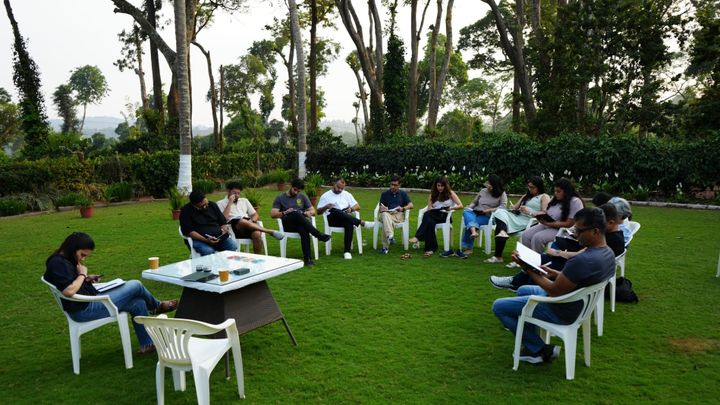
DesignScape Coorg, held from April 16–19, 2026, brought designers and design leaders together for a four-day retreat organised by Extended Pack Collective. The gathering included leaders from reputed organisations across technology, mobility, finance, retail, industrial automation, and consumer electronics:
- Biju Damodaran, Design Director for Emerging Markets at Amazon
- Madhumita Gupta, Director of Product Design – Industrial Automation at Honeywell
- Monica Deshpande, Experience Design Director at Wells Fargo
- Sameer Bhiwani, Director of UX Design at Target
- Bikash Jyoti Biswas, Head of Design at Ather Energy
- Debayan Mukherjee, Head of Design at Samsung Electronics.
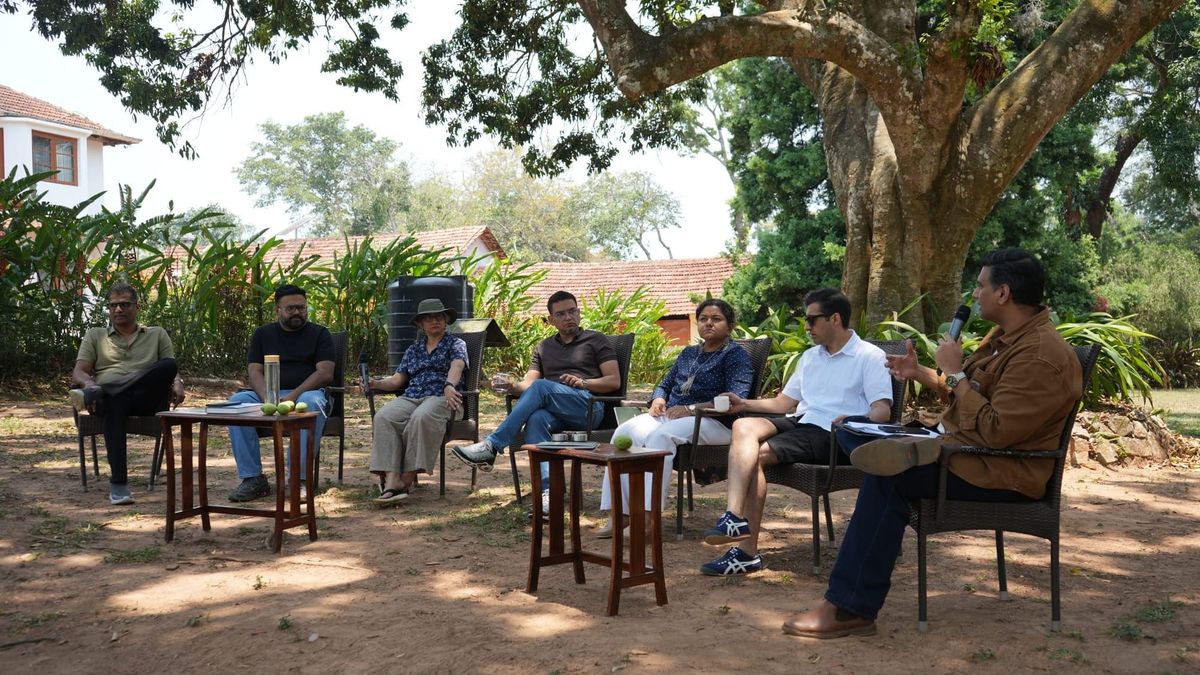
One of the sessions at DesignScape was a panel discussion on the real trade-offs design leaders face when building products, teams, and cultures inside organisations.
The conversation moved across a few questions: What should never be compromised when timelines are tight? How do leaders balance speed with trust? When does data help, and when does it limit imagination? How do teams scale without losing quality? What does leadership look like when every decision has a cost?
When trade-offs begin, trust becomes the first test
In the life of any product, trade-offs are unavoidable. Teams negotiate between speed, quality, business pressure, customer need, reliability, team capacity, and long-term ambition. But customer trust cannot be treated casually.
A product may be early. It may be in beta. It may still be growing. But when users begin to depend on it, they are already placing their trust in the company. That trust carries responsibility. The panel drew a clear distinction between shipping something unfinished and shipping something unreliable in a way that affects the user’s confidence or safety.
This is especially important in categories where the product supports financial, operational, mobility, or everyday decisions. In such cases, design leadership cannot focus solely on the polish of experience. It also has to protect the reliability of the promise.
When a company asks users to believe in a product before it is fully mature, it should be careful not to break that belief.
Leadership is also about protecting people
The panel spoke about the pressure on design teams today. Teams are becoming leaner. AI is changing production expectations. Roles that were earlier split across UI, visual design, product design, research, and systems are increasingly being compressed. In many organisations, the expectation is to do more with fewer people. That changes the nature of leadership.
The panel noted that burnout is not always visible. Some designers take on pressure before it is formally placed on them. Some do more than they should because they want to prove themselves. Some keep working until the strain becomes difficult to reverse.
In such moments, leadership requires closer attention. Leaders need to understand the person, the skill level, the nature of the problem, and the kind of pressure being placed on the team. They also need to communicate that reality clearly to business leadership, especially when expectations become unreasonable.
Protecting the team is not separate from protecting the work. When people are stretched beyond their capacity, judgment weakens, quality drops, and the product eventually suffers.