What emerging markets can teach us about design leadership
What can emerging markets teach us about design leadership? Explore how designers can work through constraints, challenge established practices, influence business decisions, and build the conditions for design to succeed.
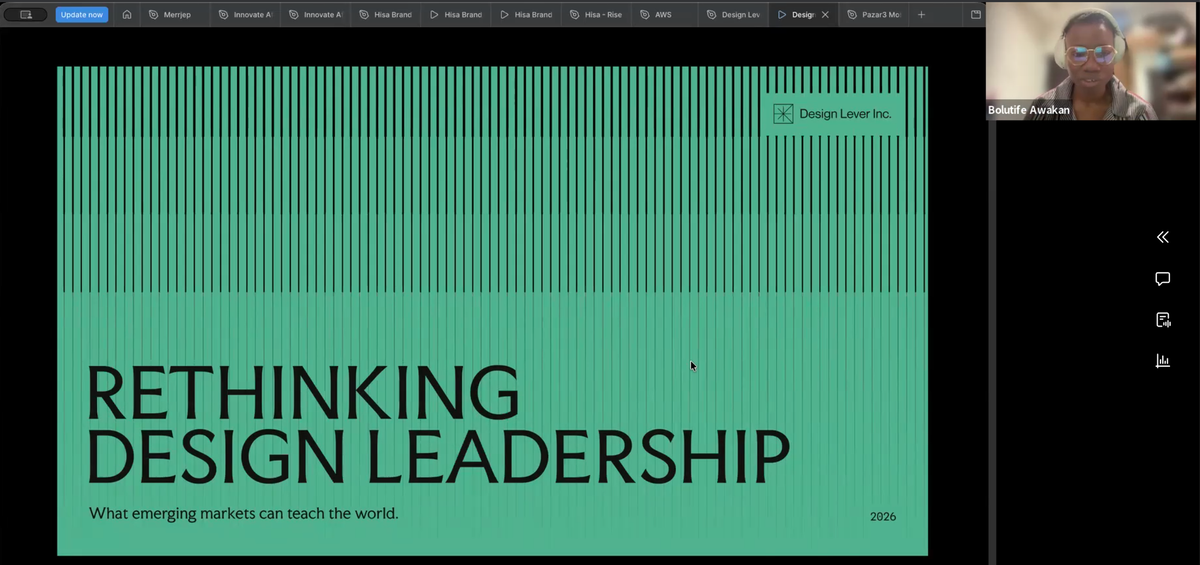
The ability to lead without ideal conditions may become one of the most valuable skills in design. Based on an Extended Pack Collective members' talk by Bolutife Awakan, Founding Partner and Chief Design Officer at Design Lever Inc.
Design leadership is often discussed through the experiences of successful organisations. We study how established companies structure their teams, conduct research, manage design systems, influence executives and measure outcomes. Over time, these practices become frameworks that other organisations attempt to adopt.
There is considerable value in learning from organisations that have invested years in developing their design capabilities. However, many of these frameworks depend on conditions that are rarely discussed. They assume access to research, sufficient budgets, experienced specialists, executive support and a reasonable level of organisational maturity. When those conditions change, the same practices may produce very different results.
During an Extended Pack Collective members' session, Bolutife Awakan, Founding Partner and Chief Design Officer at Design Lever Inc., examined this problem through her experience leading design in Nigeria and other African markets. Her talk, Rethinking Design Leadership: What Emerging Markets Can Teach the World, offered a different perspective on what makes someone an effective design leader.
Her central argument was that leadership should be evaluated partly by its ability to produce results when the conditions supporting it change. This ability, which he described as leadership portability, has become particularly relevant as organisations face tighter budgets, changing business priorities, smaller teams and the growing influence of artificial intelligence.
Every design playbook has dependencies
A design leader working in a mature organisation may have access to dedicated researchers, content designers, product managers, data analysts and experienced engineering teams. Decisions are supported by established processes, and executives may already understand the commercial value of design.
Consider the same leader moving into a smaller company with four designers, no research department, limited funding and a CEO who believes design is primarily about improving interfaces. The leadership methods that worked previously may no longer be practical.
Bolutife encouraged participants to examine the conditions that make their leadership effective. Budget, headcount, decision-making authority, specialist talent, research access and executive sponsorship are all dependencies that can influence outcomes. This raises an important distinction between capabilities that belong to an individual and capabilities provided by the organisation.
A leader may be excellent at making research-informed decisions because a dedicated research team consistently provides reliable evidence. Another may be effective at managing multidisciplinary teams because those teams were already established before their arrival. Someone may appear highly influential because the organisation already values design.
These are genuine accomplishments, but they do not necessarily demonstrate an ability to create the same conditions independently. A useful way to evaluate leadership is to examine which capabilities would remain effective if some of these supporting conditions disappeared.