Design for social good by designing better relationships
Design for social good isn't just about better products or services. It is about the relationships they create between people, communities, institutions and systems, and the conditions those relationships make possible.
Design for social good is often understood as a special category of work. It is associated with public services, non-profits, humanitarian projects, climate initiatives or products created for underserved communities. Commercial design, meanwhile, is placed in another category—focused on growth, efficiency, engagement and revenue.
This separation is becoming harder to defend.
Every product, service, platform and system changes how people behave. It influences who participates, who gets excluded, how decisions are made, where trust is placed and how people relate to one another.
A product does not need to carry the label of social impact to produce social consequences.
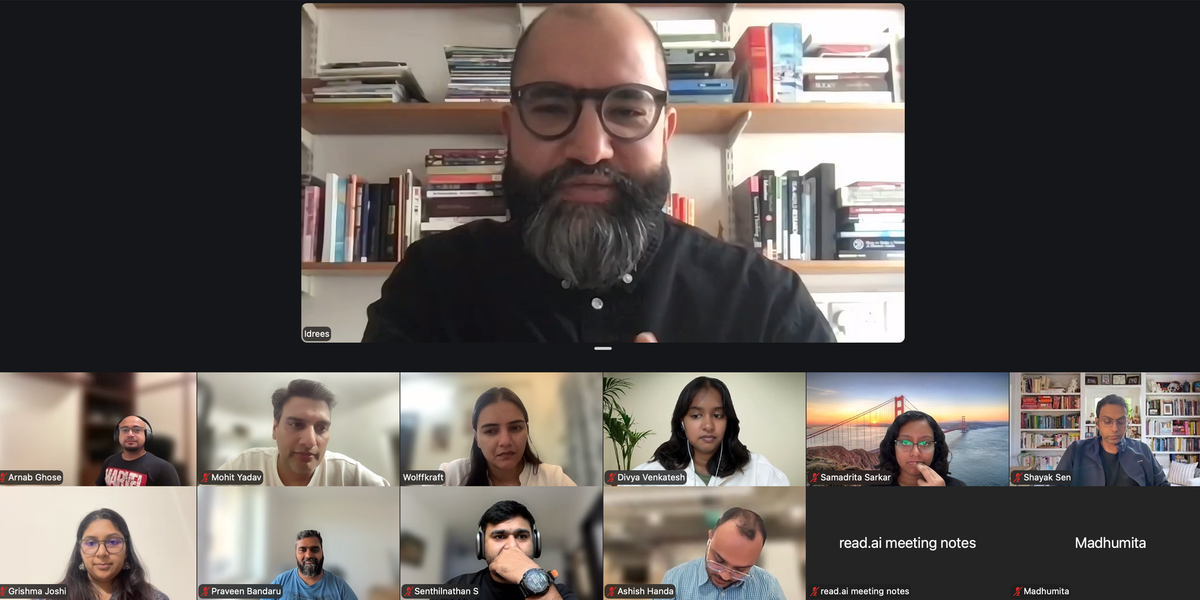
This was the central idea explored during a members-only EPC conversation with Dr. Idrees Rasouli, Associate Professor of Design and Urban Innovation at ARU Cambridge.
His presentation introduced the Thinking City, a framework for looking at social good not merely as the outcome of a well-designed product, but as something that emerges through stronger relationships between people, communities, institutions, businesses, technologies and places.
The presentation was followed by a wide-ranging discussion with EPC members. The conversation moved beyond theory and addressed the difficult parts of the practice: power, conflicting values, business pressures, cultural differences, experimentation, behaviour change and the question of who gets to define what is good.
The discussion offered a larger proposition for designers:
The next phase of design may not be about creating better things. It may be about creating better conditions for people to live, learn, decide and act together.
Social good cannot be judged by the product alone
Design teams are used to measuring success through functionality, usability, efficiency, adoption, engagement and scale.
These measures matter. A product that is difficult to use will struggle to create any meaningful benefit. A service that people do not adopt will have little effect. A programme that cannot operate reliably may not survive.
But these measures do not answer the most important question:
Did the design improve society?
A platform can have millions of users and still weaken trust.
A service can be efficient while excluding people who do not fit its assumptions.
A product can generate high engagement while encouraging unhealthy behaviour.
A public initiative can be created with good intentions and still fail the people it was supposed to support.
Design success and social benefit are not automatically the same.
The missing part is often what happens between people after the product enters their lives.
Does it encourage participation?
Does it improve access?
Does it allow people to support one another?
Does it create dependence on an organisation or build the community’s own capacity?
Does it strengthen trust or make trust unnecessary by replacing human relationships with transactions?
These questions reveal that the true output of design is larger than a product or experience.
The hidden output of design is relational infrastructure
Designers commonly describe their work as a combination of product, experience and value.
Dr. Rasouli proposed another output: relational infrastructure.
Relational infrastructure is the network of behaviours, expectations, dependencies and interactions that a design creates around itself.
Consider a digital health service. Its visible output may be an application that allows people to book appointments, access reports or speak with a doctor. Its relational effects are wider.
It changes the relationship between patients and doctors. It affects the role of hospitals and clinics. It determines which information patients can access. It may increase convenience for some people while making care more difficult for those with limited digital access. It may give people more control, or it may make them more dependent on an automated system.
The application is the visible design. The relationships it changes are the deeper design.
The same applies to workplace software, transport systems, public services, financial products, educational platforms and social networks.
Every design organises relationships. It changes how people participate, whom they depend upon, where power sits and what behaviour becomes normal.
This means that designers are never only designing an interface, object or process. They are also shaping the conditions around it.
A product solves a task. Its relational infrastructure shapes what happens after the task is completed.