Design is an economic act.
What EPC’s conversation with Simon Gough reveals about strategy, value, metrics, and the future role of design.
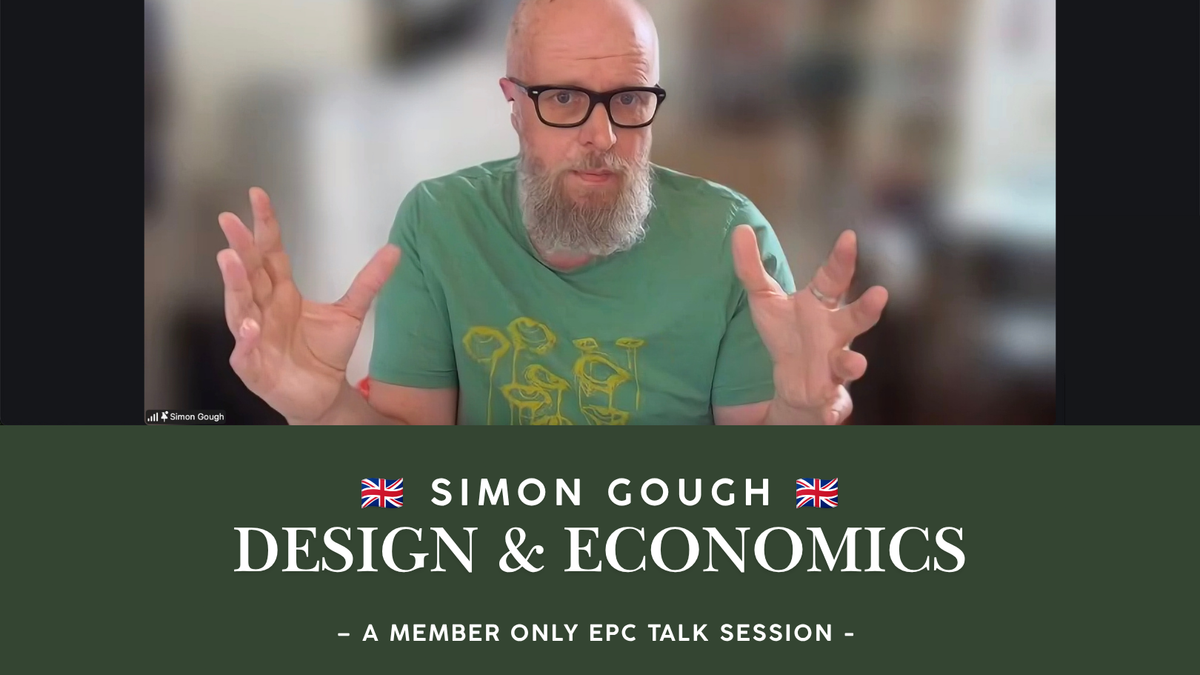
EPC hosted Simon Gough, co-founder of Design and Economics, for a members-only conversation with designers and design leaders. The session explored a topic that often sits beneath every design decision: economics. Not just money, budgets, pricing, or ROI, but the larger systems of value, trade-offs, priorities, incentives, resources, and futures that shape what gets designed and what never gets the chance to exist.
More than just making designers sound more like business people, this conversation was about helping designers understand that every product, service, interface, policy, workflow, and business model already sits within an economic system.
Design does not happen outside economics. Design is one of the ways economics becomes visible.
The missing layer in most design conversations
Designers are often trained to focus on the visible parts of work: flows, screens, journeys, systems, services, research, usability, brand, behaviour, and experience. But behind all of these are invisible forces: budgets, priorities, incentives, risk, growth pressure, operational limits, market logic, stakeholder power, and institutional belief.
This is where design and economics meet.
A designer may be working on a checkout flow, an enterprise dashboard, a public service, a subscription model, or a content platform. On the surface, the task may look like a design problem. Underneath, it is also an economic problem.
Who gets value?
Who pays the cost?
Who has the power to decide?
What behaviour is being encouraged?
What future is being made easier?
What future is being made impossible?
Design is never just about what users see. It is also about the economic forces they are made to live inside.
This is especially important because designers are usually asked to deliver within constraints they did not create. A business decides the target. Product decides the roadmap. Sales decides what matters. Finance decides what is affordable. Leadership decides what is strategic. Then the designer is asked to “make it work.”
The session challenged this default role. Designers should not only respond to economic systems. They should learn to read them, question them, and reshape them.
Design and economics are both ways of shaping the future
Design and economics can feel like opposite worlds. Design often speaks about possibility, imagination, behaviour, futures, people, and meaning. Economics often addresses resources, allocation, costs, money, incentives, trade-offs, and growth. But both are actually concerned with the future.
Businesses invest in what they believe will matter later. Governments fund what they believe deserves priority. Founders raise capital around a future they want to build. Product teams allocate resources based on the outcomes they expect. Designers create artefacts that make a future feel possible before it exists.
Design imagines the future. Economics decides what the future is allowed to cost.
A powerful idea from the conversation was that organisations are not always limited by what they currently have. They are often limited by the future they can imagine and commit to.
Many companies define strategy based on current capabilities: what they already know, what they already have, what they are already good at. But an ambitious strategy often works differently. It starts with intent. It begins with a future that the organisation is not yet ready for, and then builds the capability, partnerships, funding, and systems required to reach it.
For designers, this is important. Design is not only a response to the present. It is a method for making a possible future tangible enough for others to invest in.
The future does not begin with resources. It begins with a direction strong enough to attract resources.